The Tyranny of Simplicity: Why a Plain Chelsea Boot Is the Hardest Thing a Bootmaker Will Ever Craft
There is a common misconception that persists even among those who consider themselves informed buyers of fine footwear. It goes something like this: decoration is complexity, and the absence of decoration is simplicity. By this logic, a Chelsea boot devoid of broguing, wingtips, or elaborate stitchwork ought to be a more straightforward undertaking than its ornamented counterpart. It ought to be quicker, less technically demanding, and forgiving of minor imperfections.
Every master bootmaker in Britain will tell you the opposite is true.
"When you brogue a boot," explains one craftsman whose workshop has occupied the same Northamptonshire premises for three generations, "you introduce a texture that catches the eye and draws attention across a surface. Small inconsistencies in the leather grain, minor asymmetries in the lasting — these become invisible beneath the visual rhythm of decorative perforations. Remove all of that, and you are left with a surface that acts like a mirror. Every decision you have ever made is reflected back at the person looking down."
This is the paradox that defines the plain Chelsea boot, and it is one that separates genuinely exceptional handcrafted footwear from the merely competent.
When Ornament Becomes a Form of Mercy
To understand why minimalism is so unforgiving, it helps to consider what decoration actually does within a design. Broguing, cap toes, contrast stitching, and medallion punching all serve an aesthetic function — they guide the eye, establish focal points, and create deliberate visual interruption. In doing so, they also perform a secondary function that is rarely discussed openly: they distribute attention so evenly across a boot's surface that no single area is subjected to sustained scrutiny.
The plain Chelsea boot refuses this mercy entirely. Its surface is continuous and unbroken, a single expanse of leather running from the toe box, along the vamp, over the instep, and up the shaft. There are no lines to follow, no patterns to admire. There is only the leather itself, the precision of the lasting, and the quality of the construction. If any of these elements fall short, the eye finds it immediately.
This is why the selection of the hide is, for the plain Chelsea, a matter of unusual consequence. A master clicker — the craftsperson responsible for cutting panels from the hide — working on a brogued boot may select sections from across a skin and rely on the decorative elements to unify them visually. Working on a plain Chelsea, the same craftsperson must identify a section of leather whose grain, tone, and character remain consistent from panel to panel. The slightest variation in surface texture between the vamp and the quarter will be visible to any attentive eye, and there is nothing within the design to soften or redirect that observation.
The Geometry of Perfection
Beyond leather selection, the plain Chelsea boot places extraordinary demands on the bootmaker's command of proportion. In an ornamented boot, the eye is given explicit guidance about where to look and how to read the silhouette. Decorative elements act as punctuation, breaking the form into legible sections and establishing a visual hierarchy. Without them, the entire silhouette must be resolved through geometry alone.
The relationship between the toe box and the shaft, the curve of the top line, the angle at which the heel stack meets the sole — each of these proportional decisions carries full weight when there is no ornament to absorb the visual burden. A toe box that is fractionally too broad or too pointed will read as a flaw in a plain boot; in a brogued design, the eye might well pass over it without registering the imbalance.
"Proportion is always important," says one London-based maker who trained under a Cordwainer's College-trained bootmaker in the 1980s. "But in a plain boot, proportion is everything. You are essentially making a case that the form itself is enough — that the shape justifies the object. If the shape isn't resolved perfectly, the whole argument collapses. There's nothing to fall back on."
This is why experienced bootmakers will often describe the plain Chelsea as the true test of a craftsperson's ability. It is not a beginning but an arrival — the work that makers turn to when they feel confident enough to stand behind their geometry without assistance.
The Lasting Process Under a Microscope
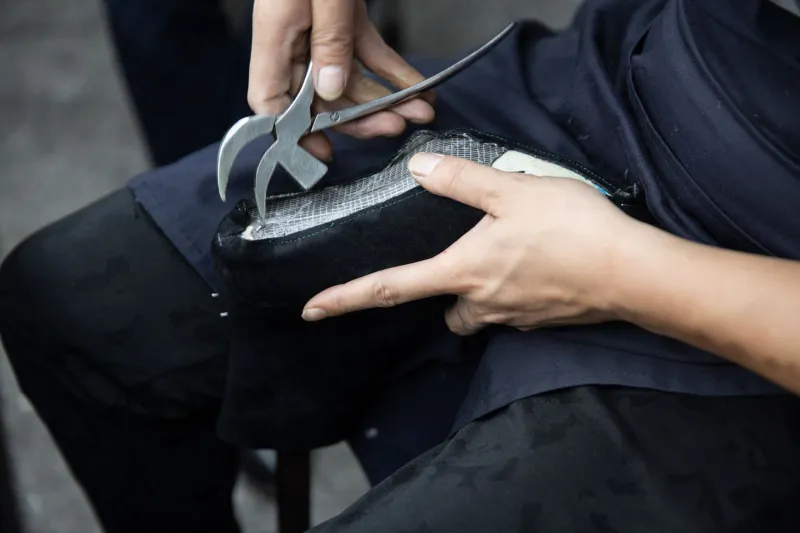
The process of lasting — drawing the upper leather over the last and securing it to the insole — is among the most technically demanding stages in bespoke bootmaking. In a plain Chelsea, the standards applied to this process are severe.
Because there are no seams or decorative lines to anchor the eye, any irregularity in the tension of the lasted upper becomes apparent in the finished boot. A slight pulling of the leather at the waist, an inconsistency in the way the toe box has been shaped — these are things that an experienced observer will notice and that no amount of polishing will conceal. The craftsperson must achieve a tension that is both uniform and responsive to the specific character of the hide, which varies in stretch and resistance across different sections of the skin.
This is skilled work of a high order, and it is precisely the kind of work that cannot be replicated by machine. Automated lasting systems operate within tolerances that are acceptable for many styles of footwear. For the plain Chelsea boot, where the surface is both the subject and the evidence, those tolerances are not sufficient.
What the Elastic Reveals
The Chelsea boot's defining structural element — the elasticated gusset at either side — presents its own particular challenge within a minimalist design. On a heavily detailed boot, the gusset can be treated as one element among many. On a plain Chelsea, it is one of only two points of visual interest, the other being the top line of the shaft.
The fit, tension, and quality of the elastic must therefore be impeccable, not merely in functional terms but in aesthetic ones. The gusset must sit flush with the leather panels on either side, neither pulling inward nor billowing outward. Its colour must be carefully matched to the upper, and the stitching that secures it must be executed with a regularity that would satisfy a watchmaker.
Many of the most experienced bootmakers will tell you that selecting the correct elastic — in terms of both its physical properties and its visual character — is one of the more time-consuming decisions in the construction of a plain Chelsea boot. The wrong elastic will undermine everything else.
The Confidence to Offer Nothing but Excellence
There is, ultimately, something deeply admirable about the plain Chelsea boot — not in spite of its severity but because of it. It is a design that makes no concessions and offers no distractions. It asks only that the maker be good enough to let the work speak entirely for itself.
For the discerning buyer, this is precisely the point. A beautifully executed plain Chelsea boot is not a simple object. It is the product of accumulated skill, rigorous material selection, and an uncompromising command of form. It is, in the truest sense, a test that only the finest craftspeople pass.
And when they do pass it, what remains is a boot of such quiet authority that it requires nothing else.