Archives in Beech and Bracing: The Quiet Afterlife of a Bootmaker's Lasts

Photo: sodai gomi, CC BY 2.0, via Wikimedia Commons
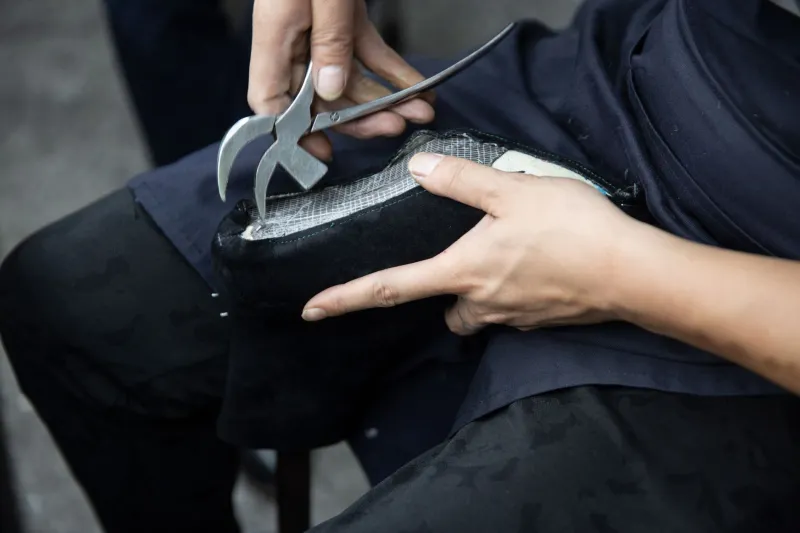
Up an unassuming staircase in a Northampton workshop, past rolls of leather and tins of bracing tacks, there is a room that visitors rarely ask to see. It holds no boots. It holds the memory of feet: row upon row of beech and hornbeam lasts, each one carved or adjusted to a single customer, each one labelled in fading pencil. Some of the orders they record date back to the 1950s. Some of the men and women they were shaped for are certainly no longer alive.
Bootmakers call these the ghost lasts, and they are among the most quietly moving archives in British craft.
Why a Last Is Never Thrown Away
To the uninitiated, a last is a tool. To a bespoke bootmaker, it is a contract. When a customer is measured and fitted, the resulting last embodies everything learned about that person's foot: the bunion that dictates the toe shape, the high instep, the leg-length difference discreetly accommodated. To discard it would be to discard that knowledge — and to break an unspoken promise that the maker will always be able to serve that foot again.
The tradition runs deep in the Northamptonshire trade, where bespoke shoemaking has been practised for centuries. Workshops that supplied officers, politicians and film stars still hold their lasts, sometimes with correspondence tucked alongside: a note about a forthcoming safari, a complaint about a heel, a thank-you letter from a widower who had his late wife's boots resoled one final time.
The Problem of Physical Memory
Wood, for all its virtues, is not permanent. Central heating dries it; damp warps it; a burst pipe in a storeroom can erase sixty years of records in an afternoon. Several historic makers have lost entire archives to precisely such accidents, and with them, the only three-dimensional record of feet that will never be measured again.
There is also the problem of space. A busy bespoke house might add hundreds of lasts a year. Storerooms fill. The temptation, in harder commercial times, has always been to burn the oldest stock — and some workshops did exactly that in lean decades, a loss the trade still mourns.
Digitising the Footprint
The most interesting development of recent years is the arrival of the scanner. Several makers now photograph and laser-scan every new last, storing the measurements digitally alongside the physical form. The scan cannot yet replace the carved object — a last's subtleties of shape are felt as much as measured — but it provides insurance against fire, flood and decay.
Some archives have gone further, digitising order books, fitting notes and even the annotated foot tracings that accompanied orders from the 1920s and 1930s. Read together, these records form an unintended social history: the changing width of the British foot, the marks of rationing-era leather shortages, the sudden fashion for narrower toes in years of prosperity.
A Promise Kept for the Next Generation
There is a growing practice, too, of lasts passing to heirs. A son commissions boots from his late father's last, adjusted where genetics and decades have altered the resemblance. A daughter inherits a shape her mother walked on. It is inheritance of an intimate kind — not jewellery or land, but the very geometry of a person's stance in the world.
At our own bench, every last is retained, labelled and archived, because we believe a bespoke boot is not a transaction but a standing arrangement. The customer may return in a year or in thirty. The last will be waiting, and with it, the promise that no foot is ever forgotten.