The Discipline Behind the Versatility: Why Chelsea Boots Demand More from Their Wearer Than Any Other Shoe

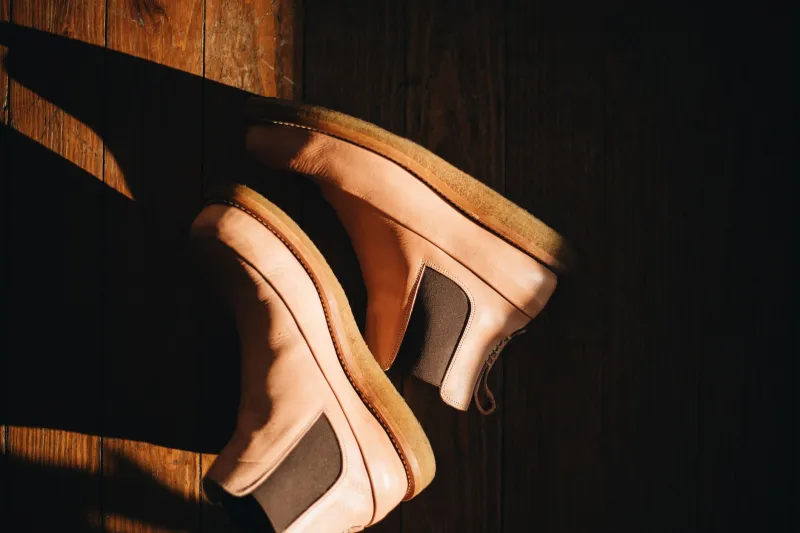
Photo: polished Chelsea boots with tailored suit and casual outfit flat lay styling, via www.nwconcreteresurfacing.com
There is a peculiar trap concealed within the Chelsea boot's most celebrated quality. Its admirers speak endlessly of versatility—of a boot equally at home beneath a Savile Row suit as it is beneath a pair of selvedge denim, equally persuasive at a gallery opening as on the cobblestones of a Sunday market. And they are not wrong. The Chelsea boot does, in fact, traverse these contexts with a fluency that no Oxford brogue or Derby shoe can match.
But versatility, it turns out, is not the same thing as effortlessness. The Chelsea boot's capacity to go anywhere is precisely what makes it so demanding to wear well. When a shoe can do everything, the wearer must decide exactly what it should do—and that decision, made dozens of times across a wardrobe's many combinations, requires a discipline that more specialised footwear never asks of its owner.
The Illusion of the Easy Boot
The conventional wisdom runs something like this: Chelsea boots are the wardrobe's universal joint. Reach for them when uncertain, and they will see you through. This counsel is not without merit, but it is dangerously incomplete. A boot without a defined role does not automatically assume a flattering one. Worn without conviction, the Chelsea boot becomes a stylistic non-answer—present on the foot, but absent from the outfit.
Consider the visual logic at work. A brogue Oxford signals formality with immediate clarity; a rubber-soled desert boot signals relaxed informality with equal directness. The wearer of either shoe need not work especially hard to communicate intent, because the shoe itself carries a strong message. The Chelsea boot, by contrast, occupies a middle register that can be pulled towards either pole—but only if the wearer actively pulls it. Left to its own devices, it simply hovers, and hovering in matters of dress is rarely an asset.
This is the Chelsea boot paradox: the shoe that requires the least thought to put on demands the most thought to wear well.
When Adaptability Becomes Aesthetic Chaos
The consequences of misunderstanding this principle are visible throughout British street life. One encounters the Chelsea boot worn beneath a formal charcoal suit, where its rounded silhouette clashes with the sharp geometry of the tailoring, creating a visual discord that neither party deserves. One encounters it equally beneath cargo trousers and an oversized technical jacket, where its inherent elegance appears not relaxed but merely lost.
In both cases, the boot has not failed. The wearer has failed to make a decision. The Chelsea boot does not automatically bridge the gap between formal and casual—it requires the wearer to commit to a position along that spectrum and then dress the rest of the outfit accordingly. The boot is the pivot point, not the solution.
The most common error is treating the Chelsea boot as a default rather than a deliberate choice. It is worn because it is there, because it is easy to pull on, because it broadly goes with most things. And broadly going with most things is not the same as genuinely elevating any of them.
The Framework: Intention Before Selection
Developing a reliable approach to wearing Chelsea boots well begins not with the boot but with the outfit. Before selecting which pair to wear, one must first establish the register of the ensemble—its degree of formality, its dominant aesthetic, its intended context. Only once that register is clear does the Chelsea boot's role become apparent.
For formal or business contexts, the boot should recede slightly, complementing rather than competing. A sleek, unadorned black calf leather Chelsea boot in a slimmer profile allows tailoring to remain the primary statement. The boot's contribution is coherence and a quiet modernity—it updates the formality without undermining it.
For smart-casual occasions, the Chelsea boot earns its reputation most fully. Here, paired with well-cut chinos, a substantial knitwear piece, and a structured overcoat, it performs its most convincing act of synthesis—drawing together elements that might otherwise feel disconnected. The boot becomes the visual anchor, lending the outfit a composed intentionality.
For genuinely casual settings, the Chelsea boot should be chosen with equal care, but different criteria. A heavier leather with a commando or crepe sole, worn with robust denim and a workwear-influenced upper half, transforms the boot's character entirely. It is no longer a refined presence; it is a rugged one. The key is that the surrounding outfit must commit to the same register. A casual Chelsea boot worn with incongruously smart separates produces the same dissonance as a formal Chelsea boot worn with rough-hewn casualwear.
Lessons from Those Who Mastered the Balance
British cultural history offers instructive examples of this discipline in practice. The late David Bowie, whose relationship with Chelsea boots was formative and well-documented, never wore them as an afterthought. Whether in the tailored glam of his Ziggy Stardust period or the more austere elegance of his Berlin years, the boot was always in conversation with the rest of the ensemble. The register was always clear, the intention always legible.
Similarly, the architects of mid-century British mod style—the figures who first established the Chelsea boot's cultural currency in the early 1960s—understood that the boot's power lay in its precision of context. Worn with slim-cut suits and narrow ties, it completed a very specific aesthetic argument. It was not worn with everything; it was worn with the right things.
More recently, figures such as Paul Weller have demonstrated a continuing mastery of this principle. Weller's styling consistently places the Chelsea boot within a fully considered framework—whether that framework is Mod-inflected tailoring, art-school casualwear, or something that borrows carefully from both. The boot is always earned, never assumed.
Curating a Wardrobe Around the Boot
For those committed to wearing Chelsea boots with the authority they deserve, the practical implication is a more edited wardrobe overall. Rather than accumulating a broad range of pieces and relying on the boot to reconcile them, the disciplined approach involves building outfits in which the boot's register is predetermined.
This means investing in separates that occupy clear aesthetic positions—tailored pieces that are genuinely formal, casual pieces that are genuinely relaxed—rather than accumulating a muddle of ambiguous middle-ground garments. The Chelsea boot can bridge registers, but it cannot resolve genuine incoherence.
It also means owning more than one pair of Chelsea boots, selected for different contexts rather than as a single universal solution. A sleek black calf leather pair for formal occasions. A tan or chestnut pair in a slightly more robust leather for smart-casual wear. Perhaps a third, in a heavier construction, for weekends and country pursuits. Each pair carries a distinct character; each demands a distinct approach.
The Reward of Discipline
None of this is to diminish the Chelsea boot's remarkable range. Its versatility is genuine and it remains, in the hands of a considered wearer, the most accomplished boot in the British wardrobe. But that accomplishment is not automatic. It is earned through the kind of thoughtful, intentional dressing that distinguishes a wardrobe from a mere collection of clothes.
The Chelsea boot, at its finest, is a reflection of its wearer's clarity of thought. It does not conceal indecision—it exposes it. Master the discipline it demands, however, and it will reward you with an elegance that no more specialised shoe can quite replicate.