Hands, Hide, and Heritage: A Day Inside the Chelsea Boots Maker Atelier
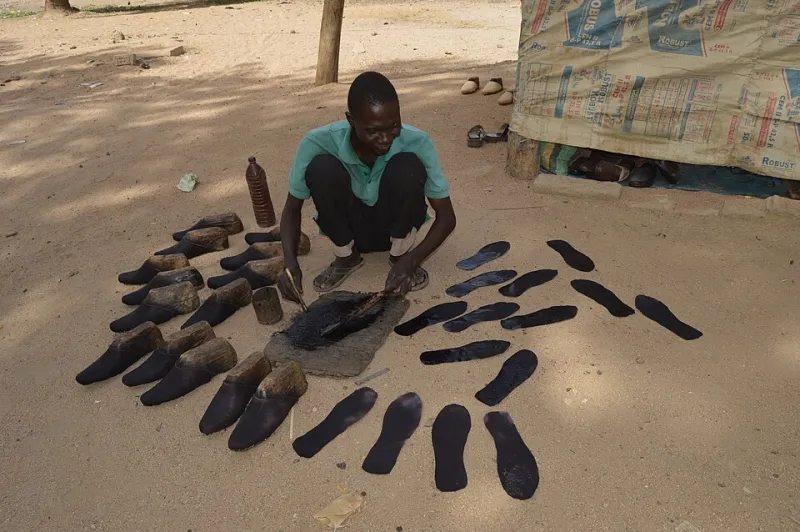
Photo: Abdouraman20, CC0, via Wikimedia Commons
There is a particular quality of silence that settles over a working atelier in the early morning hours. It is not the silence of emptiness, but of purpose — the kind that precedes something meaningful. At the Chelsea Boots Maker workshop, before the first customer enquiry arrives and before the day's correspondence begins, the craftspeople are already at their benches, running fingertips along leather panels, checking the grain, assessing the fall of light across a surface that will, within days, become someone's most cherished possession.
This is where the brand's promise — Handcrafted Heritage. Worn for a Lifetime — is not merely articulated, but earned.
The First Touch: Selecting the Leather
Every boot begins long before a single tool is lifted. It begins with leather selection, a process that demands both knowledge and intuition in equal measure. The hides that arrive at the atelier originate from a small number of trusted British and European tanneries, each chosen for their adherence to slow, traditional methods — vegetable tanning processes that may take weeks or even months, as opposed to the accelerated chemical treatments favoured by volume manufacturers.
Senior cutter Margaret, who has worked in the trade for over two decades, describes this initial stage as the most consequential of all. "You're looking for consistency in the grain, the right temper in the leather — not too stiff, not too yielding," she explains, pressing her palm flat against a panel of dark chestnut calf. "A poor selection here cannot be corrected later. The leather tells you what it wants to become."
Each hide is inspected by hand and eye before being approved for cutting. Imperfections — small scars, uneven dye absorption, inconsistencies in thickness — are noted and, where possible, accommodated rather than discarded. In lesser workshops, such marks might be grounds for rejection. Here, they are occasionally celebrated as evidence of natural origin.
The Craft of Cutting
Once approved, the leather moves to the cutting table, where patterns are laid with almost architectural precision. The Chelsea boot's deceptively simple silhouette — its clean lines, its elastic side panels, its absence of lacing — demands a standard of cutting that leaves no room for approximation. A misaligned vamp, a panel cut fractionally off-grain, will announce itself in the finished boot with the kind of subtlety that only a trained eye detects, but that the wearer invariably feels.
The atelier's cutters work with both traditional clicking knives and, for certain components, steel-rule dies — though the hand remains the final authority. Apprentice cutter Thomas, now entering his third year of training, speaks with candour about the learning curve. "I thought I understood precision before I came here," he admits. "I didn't. Precision in this trade is something you develop over years, not weeks. You begin to feel when something is right before you can fully explain why."
This intergenerational transmission of knowledge — from senior artisan to apprentice, from gesture to gesture — is perhaps the most significant form of quality control the atelier possesses.
Lasting: Where Shape Is Born
If cutting is the intellect of bootmaking, lasting is its physical expression. This is the stage at which the upper leather is stretched, tensioned, and secured over a wooden last — a foot-shaped form that determines the boot's final character. The process requires a combination of strength and sensitivity that is difficult to describe to anyone who has not attempted it.
Master laster David has been plying this particular craft for thirty-one years. Watching him work is, in its own way, a lesson in what mastery looks like: the leather drawn taut without distortion, the heel seat pulled firm, the toe shaped with a series of deliberate, unhurried movements. There is no rushing this stage. The leather must be coaxed, not forced.
"Every last is slightly different, and every hide behaves differently," David observes, without pausing his work. "You learn to read the material. When you've done it long enough, the boot starts to feel right in your hands before it looks right to your eyes."
For bespoke commissions, the last itself is made to measure — a precise wooden representation of the individual customer's foot, retained by the atelier for future orders. It is, in a very real sense, a portrait of the wearer kept in perpetuity.
The Welt, the Sole, and the Finish
Goodyear welting — the method by which the upper, insole, and outsole are joined via a continuous strip of leather — is the construction standard at Chelsea Boots Maker, and for good reason. It is a technique that allows the boot to be resoled multiple times without compromising the upper, transforming a fine boot into a lifelong companion rather than a seasonal purchase.
The stitching of the welt is performed by hand on bespoke commissions and by a specialist machine on the ready-to-wear range, though in both cases the result is inspected stitch by stitch before the sole is attached. The sole itself — typically leather for dress occasions, crepe or rubber for country wear — is then burnished, edges inked, and the heel stacked and nailed with the kind of methodical attention that transforms functional components into something approaching sculpture.
Finishing is the final act, and it is here that the boot acquires its voice. Creams and waxes are applied in layers, each buffed back before the next is added. The elastic gussets are checked for symmetry and tension. Pull tabs are examined. Every surface is scrutinised under strong directional light.
Why It Matters
In an age when footwear can be manufactured at scale, shipped across continents, and sold at a fraction of the price, one might reasonably ask why any of this still matters. The answer, perhaps, is simpler than it first appears.
A boot made in this manner carries within it the accumulated judgment of the people who made it. It carries the knowledge of Margaret's leather selection, the precision of Thomas's cut, the strength and sensitivity of David's lasting. It carries, in other words, something that cannot be automated or replicated at volume: human care, applied with expertise, over time.
That is what the maker's mark truly signifies. Not a logo, not a label — but a guarantee, implicit in every seam and surface, that someone who knew what they were doing cared deeply about what they were making.
And that, for the discerning wearer, makes all the difference.