Written in Leather: How to Read the Handcrafted Signatures Hidden Within Every Exceptional Chelsea Boot

Photo: craftsman hands stitching leather boot close up workshop, via i.etsystatic.com
There is a particular moment that seasoned collectors of fine footwear describe with remarkable consistency. It occurs when they turn a newly acquired Chelsea boot over in their hands — not to inspect it for faults, but to read it. To study the slight irregularities in the welt stitching, the faint impression of a lasting tool along the insole's edge, or the barely perceptible variation in the leather's surface where a craftsperson's thumb pressed firmly during lasting. In that moment, they understand something that no product description or marketing photograph can convey: this boot was made by a person, not a process.
For those newer to the world of handcrafted footwear, these same details can appear, at first glance, to be imperfections. They are anything but. Learning to distinguish the marks of genuine craftsmanship from the defects of poor manufacture is one of the most valuable skills a discerning buyer can develop — and one that, once acquired, makes the prospect of returning to mass-produced alternatives almost unthinkable.
The Welt: Where the Story Begins
The Goodyear welt is the structural spine of a quality Chelsea boot, and it is also among the most revealing indicators of how a boot was made. On a machine-produced boot, the welt stitching exhibits a regularity that is, paradoxically, its most damning characteristic: perfectly uniform spacing, identical stitch depth, and an almost clinical consistency that no human hand could sustain across an entire production run.
A handwelted boot tells a different story. The stitches are close and even, certainly — a skilled craftsperson takes considerable pride in their regularity — but examined closely, one finds minute variations in tension and spacing that speak to the rhythm of a human hand at work. There may be a stitch pulled fractionally tighter at a point of particular stress, or a slight deviation in angle where the welt curves around the toe. These are not errors. They are evidence of judgement: a craftsperson reading the leather and responding to it in real time, making decisions that a machine cannot.
Lasting Marks and the Impression of Intent
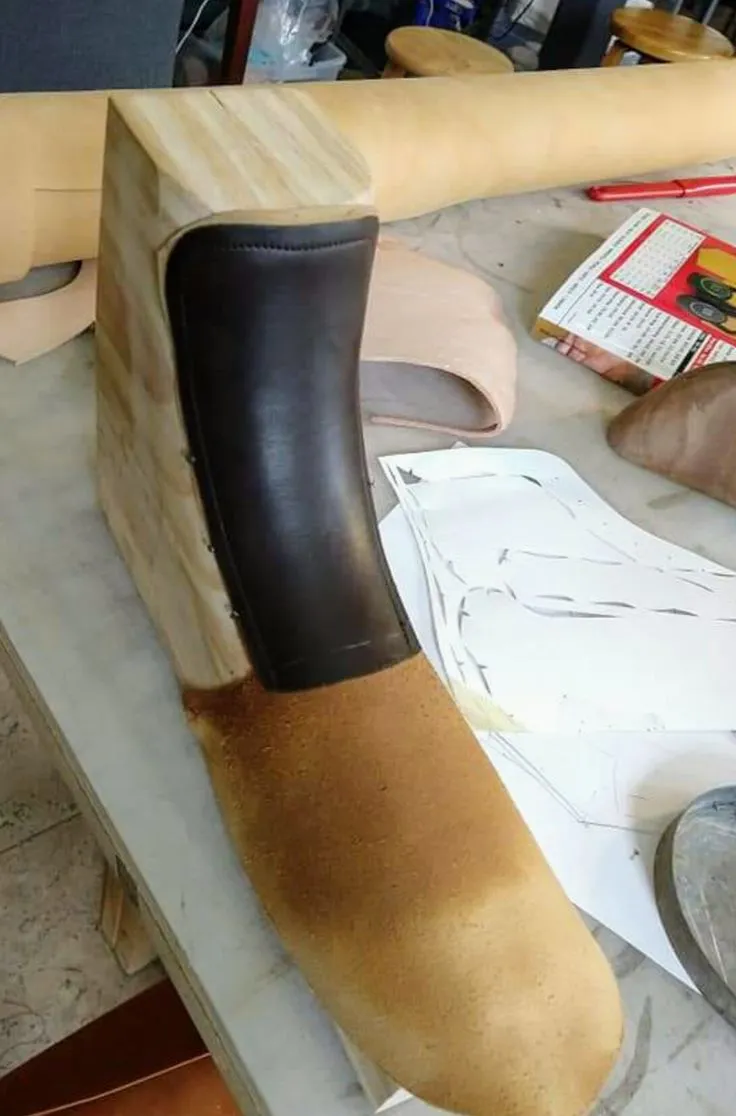
The lasting process — in which the upper leather is stretched over a wooden last and secured to the insole — leaves its own set of signatures. In hand-lasting, the craftsperson uses lasting pliers to grip and tension the leather with considerable force, and the inner face of the insole frequently bears faint impressions of this work: small, irregular compressions where the tool made contact, or slight asymmetries in the tack placement that differ subtly from boot to boot.
Run a finger along the interior of a handcrafted Chelsea boot and you may also detect a gentle undulation in the insole's surface — the natural consequence of leather responding to the human hand rather than to hydraulic pressure applied uniformly across a mould. This tactile quality is not merely aesthetic. It speaks to a lasting process in which the craftsperson was able to respond to the particular character of each piece of leather, coaxing it into shape rather than forcing compliance.
The Elastic Panel: A Detail Rarely Examined, Richly Informative
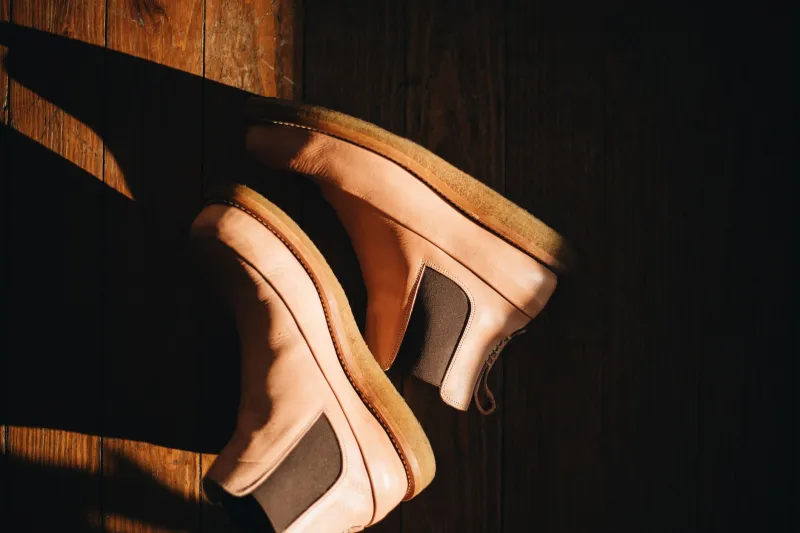
The twin elastic gussets that define the Chelsea boot's silhouette are, for many buyers, purely functional considerations. For the informed observer, they are something more. In a handcrafted boot, the elastic panels are set by hand, and the stitching that secures them to the upper leather carries its own distinctive character. The thread tension varies slightly with the craftsperson's pace and angle of work; the corners where elastic meets leather reveal the particular technique of the individual who set them.
Perhaps more telling still is the alignment of the panel itself. A handcrafted boot may exhibit a fractional asymmetry between the two gussets — not enough to affect function or appearance when worn, but visible upon close inspection. This is not a quality failure. It is the natural consequence of two panels being set by the same pair of hands working in sequence, each one an individual act of craft rather than a replicated mechanical operation.
Surface and Finish: The Patina of Deliberate Work
The finishing of a handcrafted Chelsea boot is where individual character becomes most visible to the eye. Hand-burnishing — the process of working wax or cream into the leather's surface using a cloth or bone tool — produces a depth of lustre that machine buffing cannot replicate. The light catches a hand-burnished boot differently depending on the angle of viewing, revealing subtle variations in the leather's surface that speak to the craftsperson's strokes.
At the edges, hand-finishing leaves its own marks. The heel stack and sole edges of a quality boot are typically stained and burnished by hand, and the resulting finish has a slight organic quality — a warmth and depth that machine-applied lacquer lacks. Similarly, the toe cap, where present, may carry the faintest evidence of the craftsperson's hand in the transition between the cap and the vamp: a line that is precise but not mechanical, confident but not rigid.
The Maker's Mark Itself
Beyond these incidental signatures, many heritage bootmakers apply their mark in more deliberate ways. A stamped maker's mark on the insole, a hand-written last number, or a craftsperson's initials pressed lightly into the leather of the sock liner — these are the explicit declarations of authorship that accompany the implicit ones described above. At Chelsea Boots Maker, each pair leaving the atelier carries the record of its making: the last on which it was built, the craftsperson responsible for its construction, and the date of completion.
This traceability is not merely a quality assurance measure. It is an acknowledgement that a handcrafted boot is not an anonymous commodity but a specific object made by a specific person at a specific moment. When a boot is resoled twenty years hence, or passed to the next generation of its owner's family, these marks provide a continuity of provenance that no mass-produced alternative can offer.
Learning to Look
The ability to read these signatures develops with practice and attention. Begin by handling boots you know to be handcrafted — whether purchased directly from a maker or examined at a reputable retailer — and study them in good light, ideally natural daylight. Turn them slowly. Examine the welt at close range. Run a finger along the insole. Compare the two elastic panels with care. Over time, the vocabulary of handcraft becomes familiar, and the difference between a boot made with genuine skill and one that merely resembles it becomes unmistakable.
This knowledge serves the buyer in practical ways. It allows for more confident purchasing decisions, a clearer understanding of what constitutes value at various price points, and a more informed relationship with the craftspeople whose work one is considering. It also, in a less tangible but no less real sense, enriches the experience of wearing a handcrafted boot — transforming it from a purchase into a relationship with an object that carries within it the evidence of another person's skill, care, and commitment to their work.