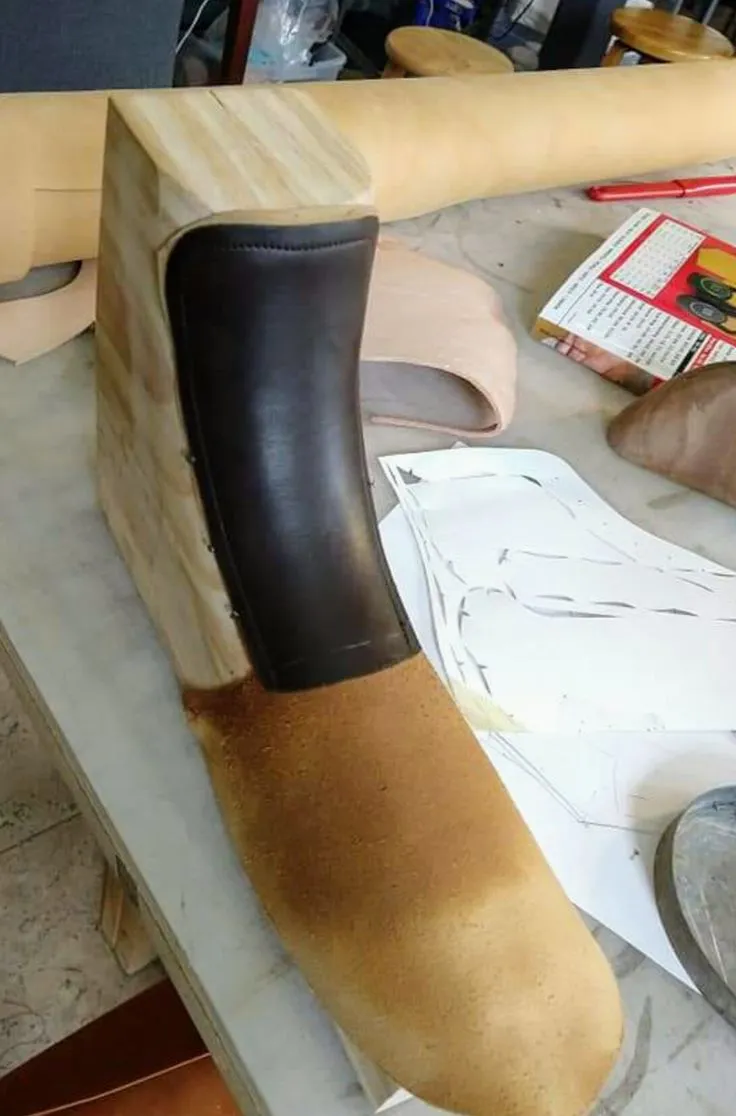
Measured in Millimetres, Felt in a Lifetime: How Proportions Define a Chelsea Boot's True Character
There is a moment, familiar to anyone who has spent time around truly exceptional footwear, when a boot simply looks right. Not fashionable, not on-trend — right. The heel appears to belong beneath the shaft in a way that seems inevitable. The toe neither crowds the eye nor trails away into emptiness. The whole object carries itself with the quiet confidence of something that has been thought through completely. What produces this sensation is not accident, nor is it the sole province of instinct. It is proportion — and proportion, in the hands of a master bootmaker, is as rigorous and as deliberate as any architectural calculation.
For those in the market for handcrafted Chelsea boots, learning to read these proportional relationships is perhaps the single most valuable skill a buyer can develop. It transforms the shopping experience from one of guesswork and brand loyalty into one of informed, confident judgement.
The Heel: Foundation Stone of Every Silhouette
Begin with the heel, because everything else is built in relation to it. The standard heel height for a classic Chelsea boot sits somewhere between 25 and 35 millimetres — a range that sounds narrow but accommodates enormous variation in character. A heel at the lower end of this range creates a silhouette that reads as grounded and utilitarian, with strong associations with working heritage and country pursuits. A heel pitched toward the upper boundary introduces an almost imperceptible forward lean that elongates the leg and lends the boot a more urban, considered air.
What separates a thoughtful maker from a merely competent one, however, is not the heel height in isolation but the heel pitch — the angle at which the heel stack meets the waist of the sole. A poorly considered pitch forces the foot into an unnatural position, creating fatigue over long wear regardless of how fine the leather may be. An expertly calibrated pitch, by contrast, places the foot in alignment with the boot's centre of gravity, distributing weight evenly and allowing the wearer to move with an ease that feels, paradoxically, effortless.
When examining a boot before purchase, place it on a flat surface and observe the angle from the back of the heel to the ball of the sole. A well-proportioned boot will show a smooth, continuous arc rather than an abrupt transition — evidence that the maker has considered the foot's biomechanics as carefully as the boot's aesthetics.
Shaft Circumference and the Question of Fit Versus Form
The shaft of a Chelsea boot — that cylindrical column of leather rising from the ankle to the mid-calf — is where many makers reveal the limits of their ambition. Mass-produced boots are almost invariably constructed to a single shaft circumference per size, a compromise that serves neither the slender-legged nor the more generously proportioned wearer particularly well.
Handcrafted makers, by contrast, understand that shaft circumference must be considered in relation to both the wearer's calf measurement and the overall visual weight of the boot. A shaft that is too generous for a slender calf creates an ungainly pooling of leather at the ankle, destroying the clean, unbroken line that gives the Chelsea boot its distinctive authority. A shaft cut too narrowly for a fuller calf creates visible strain in the leather and, over time, accelerates wear at the elastic gusset — the very element that defines the style.
The ideal relationship between shaft circumference and heel height follows an intuitive logic: as heel height increases, the shaft should taper very slightly to maintain visual equilibrium. This is a subtlety that most buyers will never consciously articulate but will feel immediately when comparing a boot made with this understanding against one produced without it.
Toe Box Depth: The Detail That Divides Makers
Perhaps no single dimension is as revealing of a maker's philosophy as the depth of the toe box — the vertical space between the top of the leather and the last at the toe. This measurement is invisible in photographs, rarely discussed in marketing copy, and almost never listed in specification sheets. Yet it is decisive.
A toe box that is too shallow compresses the toes over the course of a long day, producing discomfort that no amount of premium leather can redeem. One that is too deep creates a visual bulge that disrupts the clean taper of the toe profile, making even the finest handcrafted boot appear clumsy. The correct depth varies according to the toe shape — a chisel toe demands different allowances than a rounded or almond toe — and a maker who applies a single standard across multiple lasts betrays a lack of the holistic thinking that genuine mastery requires.
To assess toe box depth before purchase, press gently on the top of the toe whilst the boot is on your foot. You should feel a small but definite space above your toes — enough to accommodate natural swelling over the course of a day's wear, but not so much that the leather collapses inward when unsupported.
Boot Length and the Proportional Arc
The overall length of a Chelsea boot — measured from the back of the heel to the tip of the toe — must harmonise with shaft height to create what craftspeople sometimes call the proportional arc: the visual sweep of the boot as it reads against the leg. A boot with a generous shaft but a short toe profile appears truncated, as though something essential has been omitted. A long, tapered toe paired with a low shaft creates an opposite imbalance, giving the impression of a boot straining forward whilst its upper remains behind.
The most accomplished makers work from a ratio rather than fixed measurements, adjusting boot length relative to shaft height according to the specific last being used. This is one reason why bespoke and made-to-order Chelsea boots so frequently outperform ready-to-wear alternatives in photographs: the proportional arc has been tuned to the individual wearer's foot and leg length, creating a coherence that no standardised sizing system can reliably replicate.
Reading Proportions Before You Buy
Armed with this understanding, the prospective buyer has several practical tools at their disposal. Photograph the boot from a consistent distance and angle, then compare it against reference images of boots you know to be well-proportioned. Observe the heel-to-shaft transition from the side: it should form a single, uninterrupted line rather than two separate elements meeting awkwardly. Run a finger along the welt — the strip of leather joining upper to sole — and note whether it maintains a consistent width around the entire circumference of the boot, an indication of the precision applied throughout the construction process.
Above all, ask questions of the maker. A bootmaker confident in their proportional thinking will answer with specificity and pleasure. One who cannot explain why a heel sits at a particular height, or why a given last was chosen for a particular leather weight, has likely not asked those questions themselves — and that, in the end, is the most revealing proportion of all.
At Chelsea Boots Maker, every design decision begins with these calculations. Because a boot built on sound proportions does not merely look exceptional on the day of purchase. It wears beautifully, ages gracefully, and remains in harmony with its wearer for as long as both endure.