Straight from the Bench: The Unvarnished Truths Master Bootmakers Want You to Know Before You Buy
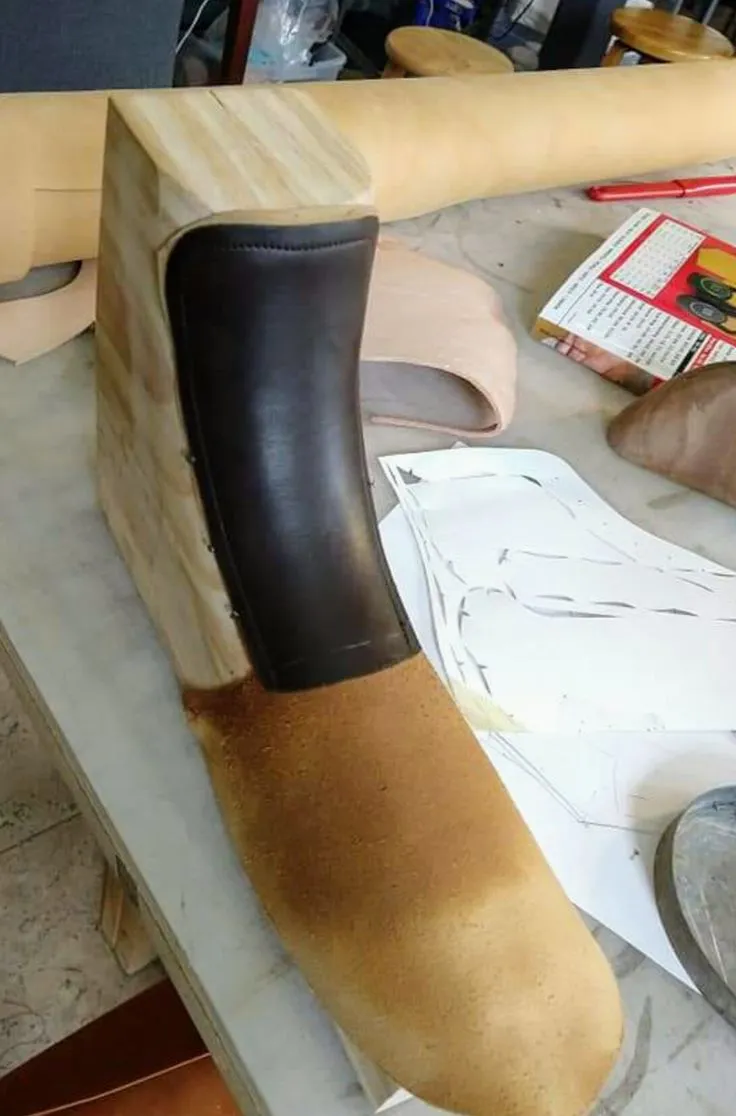
Photo: master cobbler craftsman working leather chelsea boot atelier workshop bench, via primary.jwwb.nl
There is a particular kind of silence in a working atelier. It is not the silence of emptiness but of concentration—the measured focus of hands that have shaped leather for thirty, sometimes forty years. Spend enough time in such a space, and you begin to understand that the most valuable knowledge in bespoke bootmaking is rarely committed to brochures. It lives, instead, in the judgement of the maker: in the way a craftsman pinches a hide between forefinger and thumb and knows, within moments, whether it is worthy of the work ahead.
We asked several of our most experienced artisans a simple question: if you could speak candidly to every customer before they made their purchase, what would you tell them? Their answers were illuminating, occasionally surprising, and always honest.
The Leather Tells the Truth Immediately—If You Know How to Listen
"The first thing I wish customers understood," says one veteran clicker with over three decades at the cutting bench, "is that leather quality announces itself before the boot is even assembled. Grain consistency, surface tension, the way light moves across the hide—these are not decorative qualities. They are structural ones."
He is describing something that marketing language tends to obscure: the difference between full-grain leather and its corrected or split counterparts is not merely aesthetic. Full-grain leather, taken from the outermost layer of the hide, retains the natural fibre structure that gives it both strength and the capacity to develop a patina over years of wear. Corrected-grain leather, by contrast, has been sanded and embossed to conceal imperfections—a process that compromises the very qualities that make leather durable.
"When someone asks me why our boots cost what they cost," he continues, "I tell them: you are paying for hides we refused to use as much as the ones we did."
This is not a trivial point. A reputable bootmaker's relationship with their tannery is built over years, sometimes generations. The ability to reject a consignment because the temper is inconsistent or the grain has been over-processed is a luxury of independence—and it has a direct bearing on what arrives on your foot.
Construction Is Not a Detail; It Is the Entire Argument
Another of our craftsmen, who trained under a Northamptonshire master before joining the atelier, is particularly forthright on the subject of construction methods. "Customers ask about Goodyear welt versus Blake stitch as though it's a matter of preference," he says. "It isn't. It's a matter of longevity."
The Goodyear welt—in which the upper, insole, and welt are stitched together before the outsole is attached—creates a boot that can be resoled multiple times without compromising the upper. Blake construction, which stitches through the insole directly to the outsole, produces a sleeker profile but limits the number of resoles the boot can sustain before the insole itself is damaged.
"Neither method is dishonest," he clarifies. "But if someone tells me they want a boot for life, I will always counsel Goodyear welt. The structure is simply more forgiving over time."
What he wishes more customers understood is that the visible finish of a boot—its polish, its symmetry, its surface lustre—can be achieved regardless of what lies beneath. The construction is invisible to the untrained eye, which is precisely why it is so often where corners are cut.
Fit Is a Conversation, Not a Measurement
Perhaps the most emphatic point raised by our artisans concerns the fitting process itself. "A size seven is not a size seven," says our head last-maker plainly. "It is an approximation. The foot is three-dimensional; a number is not."
This is why the bespoke process begins not with a catalogue but with a fitting—an exchange of information between the maker and the wearer that encompasses not just length and width but instep height, heel cup depth, toe box preference, and the specific demands of the customer's daily life. Do they walk on cobblestones? Stand for long periods? Favour a particular heel pitch for comfort?
"I have had customers come to me after years of discomfort in ready-to-wear boots, convinced that their feet were simply difficult," he says. "In almost every case, the problem was not the foot. It was the last."
For those purchasing ready-to-wear rather than bespoke, his counsel is equally direct: do not buy a boot expecting to stretch it into comfort. A boot that pinches on the first wearing will not improve with goodwill alone. The break-in period is real—leather does soften and yield—but it is not a remedy for fundamental misfit.
Patience Is Part of the Specification
There is one truth that our craftsmen return to with striking consistency: a boot made to last requires a wearer prepared to wait. "Bespoke takes time because the work takes time," says our senior stitcher. "Anyone who tells you otherwise is either rushing or outsourcing."
A fully handcrafted Chelsea boot, made on a bespoke last with full Goodyear welt construction and premium hide, requires upwards of forty hours of skilled labour. The clicking, closing, lasting, welting, soling, and finishing are each discrete disciplines, and each demands the kind of attention that cannot be accelerated without consequence.
"What I find difficult," he admits, "is when customers compare our lead times to fast-fashion turnarounds. The comparison doesn't hold. We are not making the same thing."
This is, perhaps, the most important reorientation a prospective customer can make: to understand that acquiring a handcrafted boot is not a transaction but a relationship—with the maker, with the material, and with time itself.
What a Boot Owes You—and What It Doesn't
Finally, our craftsmen are candid about expectation management. A handcrafted Chelsea boot will not be flawless in the way a machine-pressed product is flawless. There will be subtle variations in the grain, minor asymmetries that reveal the human hand behind the work. These are not defects.
"People sometimes confuse perfection with quality," says our head finisher. "A machine can produce a perfectly uniform surface. But that uniformity is inert. Handwork has character—and character, over time, becomes beauty."
What a well-made boot does owe you is structural integrity, material honesty, and the capacity to be repaired. It owes you a decade of service, at minimum, and potentially a great deal more. What it cannot promise is immunity to neglect. Conditioning, cleaning, and periodic resoling are not optional maintenance tasks; they are the terms of the agreement.
"The boots I'm most proud of," says one maker quietly, "are the ones that come back to me for a resole twenty years on. That is the whole point."
And there, in that single sentence, is everything a prospective customer needs to understand before they buy.